AI Startup Moats: Easy for You Means Easy for Everyone
Hollywood tech veteran Michael Wise told Moat founders where AI startups can still build a moat, when to pivot, and how to make unpopular calls.
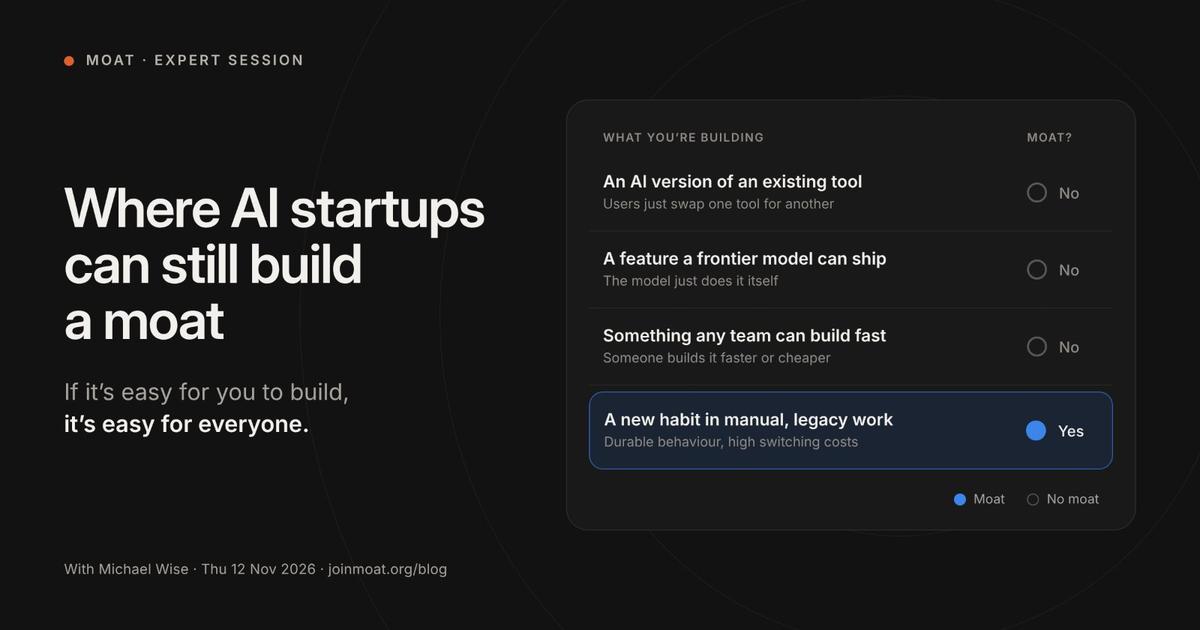
Most AI startups struggle to build a moat because AI has lowered the barrier to entry for everyone. If a product is easy for you to build, it's easy for every other team, and often for the frontier models too. The openings that are still defensible sit in legacy behaviour: work people still do by hand, where AI can create a new habit that sticks and is costly to switch away from.
That was Michael Wise's answer when founders asked him where the AI opportunities are, at a live Moat expert session on 12 November.
Michael learned to code in a high school computer lab in an Idaho town of about 2,000 people. In the late 80s and early 90s, as a student, he was one of roughly 30,000 people on the internet. Since then he has done systems work on a NASA supercomputing project, built one of the first content delivery networks at AOL, run the first 24/7 webcast of Big Brother and built March Madness Live. At Universal Studios Hollywood, his team built a VR prototype synced to a real car's telemetry: riders sat in a virtual hearse driven by the Bride of Frankenstein, shooting at monsters while a real driver took them round the park. People loved it, but it was too expensive to scale. Now he's building a startup of his own, Twitch-style interactive viewing for movies and TV.
Why most AI ideas have no moat
Over the past year Michael has looked at a stack of AI ideas in his own space, from creative and editing tools to infrastructure. Most of the time, either someone else could build it faster or cheaper, or a frontier model simply did it.
About a year ago he worked on an idea for a new, AI-powered Adobe Premiere. The market looked huge. Then it became clear lots of others had spotted the same gap, and there was no way to build a moat. Editors wouldn't be doing anything new, just swapping one tool for another, so there was no greenfield market to win.
Where AI startups can still build one
Michael sees the opportunity in legacy behaviour: places where people still work manually or do things the hard way. If AI changes how they work in a way that lasts, and leaving would cost them, you have something defensible. Switching costs are one of the oldest types of moat, and AI doesn't remove them.
Our startup moat guide covers the main types of moat. To see how investors are likely to read yours, get your Moat Score.
Check three things before you chase a trend
Michael was upfront that he has been wrong about trends more often than right. His team put serious work into VR, and it never went anywhere meaningful. The technology blew him away, but people weren't ready to wear a headset for hours a day.
So he runs every idea past three questions:
- Where is the technology heading, and how soon will it get there?
- Where are consumers? Is the behaviour there yet, or are you early?
- Is there an actual business to be had?
Nail the first and miss the second and you're on a fool's errand, however good the demo looks. He keeps up by reading the trades, using new products and talking to his network constantly.
Know when conviction turns into stubbornness
An earlier version of Michael's current startup had a weaker business model, and he was completely sure of it anyway. After around 15 VC meetings went nowhere, he accepted there was something there, just not that, and pivoted.
To know when to hold and when to change course, he crowdsources feedback hard, from as many backgrounds and perspectives as he can find, and especially from people who will tell him an idea is stupid. In a big company nobody wants to say that to the boss, so he learned to go looking for honesty on purpose. The earlier an idea is invalidated, the better.
If the call is unpopular, it had better be right
Someone asked how Michael handles controversial calls, admitting they often play devil's advocate with their own team.
His rule: if a call is unpopular, it had better be right. Force one through and get it wrong, and the team stops trusting you. What matters most is bringing enough people along on the why, even when the decision isn't good for them personally.
He shared an example from Hollywood awards season. Filmmakers want tens of thousands of Academy and guild voters to watch their films before release. Michael was the unpopular one pointing out that some of those copies would end up online, and that piracy could cost millions. He laid out the trade-off for the filmmaker, the awards team and the revenue team: what is a nomination worth to you, and what is it worth to wait a few weeks for the theatrical release?
The person asking had seen two styles work, one leading with logic and data and the other with emotion and a shared goal. Michael called it situational leadership, because people are motivated differently.
Later, asked what teams waste the most time on, he came back to the same idea. Teams can go round in circles chasing consensus, and sometimes the leader has to make the call as a benevolent dictator, in a way that doesn't leave anyone feeling talked over.
Big company versus startup
Michael said starting something inside a big company was easier, especially in the senior role he had. A lukewarm yes and he could have a team building a prototype and a working demo within weeks. Scaling it was the hard part, because between funding, legal, PR and sign-offs, around ten people could quietly veto it.
Running his own startup, he can validate ideas freely without a company's assumptions colouring the results. But nothing moves unless he moves it, and the hardest early problem is finding cofounders willing to build with him before there's funding.
If you're a seasoned technical builder who has taken a consumer app from prototype to millions of users, Michael is looking for a cofounder. Get in touch and we'll make the intro.
Thanks to Michael for his time, and to every founder who brought a question.
Get your Moat Score
Moat founders bring questions like these to operators who have been there. If you want to see how investors are likely to read your startup before you start pitching, get your Moat Score.
FAQ
Can an AI startup have a moat?
Yes, but rarely from the technology alone, because AI makes building easier for everyone at once. Michael Wise's view is that defensible AI startups turn a legacy, manual way of working into a new habit that lasts and is costly to leave.
Why is it hard to build a moat in AI?
The barrier to entry has dropped. If a product is easy for you to build, other teams can copy it quickly and frontier models may do the same job. Replacing one existing tool with an AI version usually means fighting for share, with no new market to win.
How do you know when to pivot a startup?
Michael gathers feedback from as many different people as he can, especially those willing to say an idea is bad. He pivoted an earlier version of his startup after around 15 VC meetings went nowhere. The earlier an idea is invalidated, the better.
Latest from the blog
-
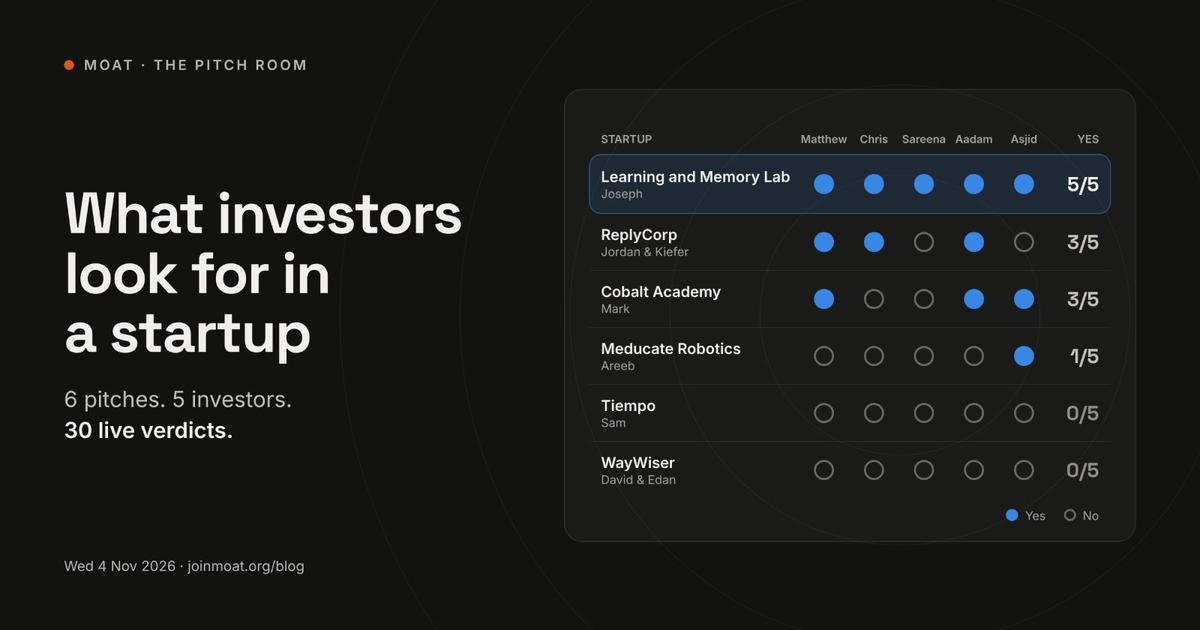
What Investors Look For in a Startup: 6 Live Pitches, 30 Verdicts
6 founders pitched 5 investors live at The Pitch Room. 12 yeses, 18 nos, one unanimous yes. Here's what the panel backed, and why.
-
LinkedIn Strategy for Founders: 7 Rules From a Ghostwriter
The LinkedIn strategy a 200+ client ghostwriter gave Moat founders: what to post, who to connect with, what to measure, and when to ask for the sale.
-
What is a startup moat? How to measure and build yours
A startup moat is what makes your business hard to copy. Learn the main types, what investors look for, and score your own moat in 3 minutes.