What Investors Look For in a Startup: 6 Live Pitches, 30 Verdicts
6 founders pitched 5 investors live at The Pitch Room. 12 yeses, 18 nos, one unanimous yes. Here's what the panel backed, and why.
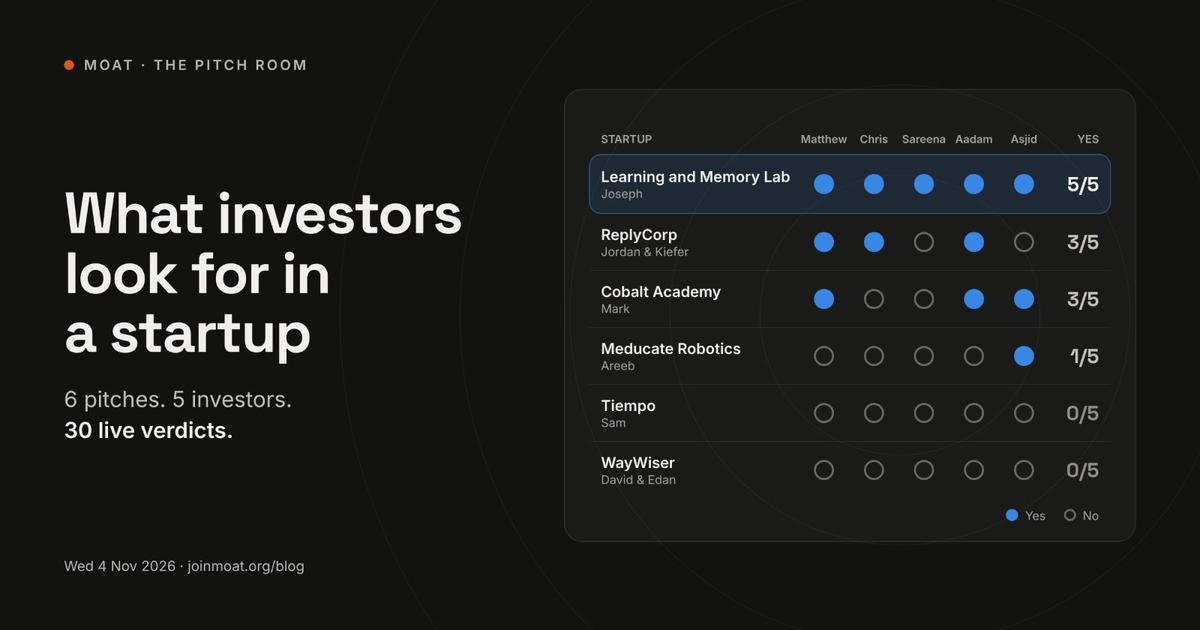
Investors look for four things in a startup: a market that's heading their way, a clear answer to "why can't a giant just do this?", a team that looks like it can scale, and a fit with what they already invest in. Those four decided most of the 30 verdicts at Wednesday's Pitch Room.
Six founders pitched live to five investors. Each judge had three yeses to give across the whole night. A yes means a follow-up call. A no means no further contact.
By the end, 12 of the 30 verdicts were yeses. One founder got all five, the first unanimous yes in Moat's history. Two founders got none, and both of them already had paying customers.
Alongside their verdicts, most judges also guessed the founder's Moat Score. Further down, I've put their guesses next to the real scores, and next to our 21 October session.
The panel
| Judge | Who they are | Focus |
|---|---|---|
| Matthew Milner | Angel investor, Venture Scout Network (around 100 scouts in 20+ countries); former ecommerce and consumer apps founder | Generalist |
| Chris Rohrer | Angel, pre-seed to seed; ex-founder (US consumer apparel, exited 2024); startup mentor | Consumer, agent commerce, blockchain |
| Sareena Bhatia | Arben Ventures (pre-seed and seed) | Women's health, deep health tech |
| Aadam Sümer | LVCN | Sector-agnostic, leans deep tech |
| Asjid Hayat | Investment Director, Palm Ventures | MENA plus a US fund; fintech, B2B, growing medtech interest |
Chris also judged on 21 October.
The results at a glance
| Founder | Startup | What it does | Raising | Yeses | Moat Score |
|---|---|---|---|---|---|
| Joseph Ayinde | Learning and Memory Lab | Learning layer for clinical AI | $5M (half closed) | 5 of 5 | 78 |
| Jordan Feinstein and Kiefer Zang | ReplyCorp | Sales attribution for organic social | $500K SAFE, $5M cap | 3 of 5 | 82* |
| Mark Handing | Cobalt Academy | Low-cost anti-drone drones | $1M | 3 of 5 | 62* |
| Areeb Iqbal | Meducate Robotics | Portable surgical robots | £130M | 1 of 5 | 72 |
| Sam Brown | Tiempo | Local executive assistants for founders | $250K pre-seed | 0 of 5 | 58* |
| David Hubbell and Edan Harv | WayWiser | AI agents for multi-location franchises | $1.5M, $15M cap | 0 of 5 | 48 |
*ReplyCorp and Tiempo took the Moat Score about two weeks before the night, so these are their scores from then. Mark's is the score he told us on the night.
Founder by founder
Joseph Ayinde, Learning and Memory Lab: 5 of 5
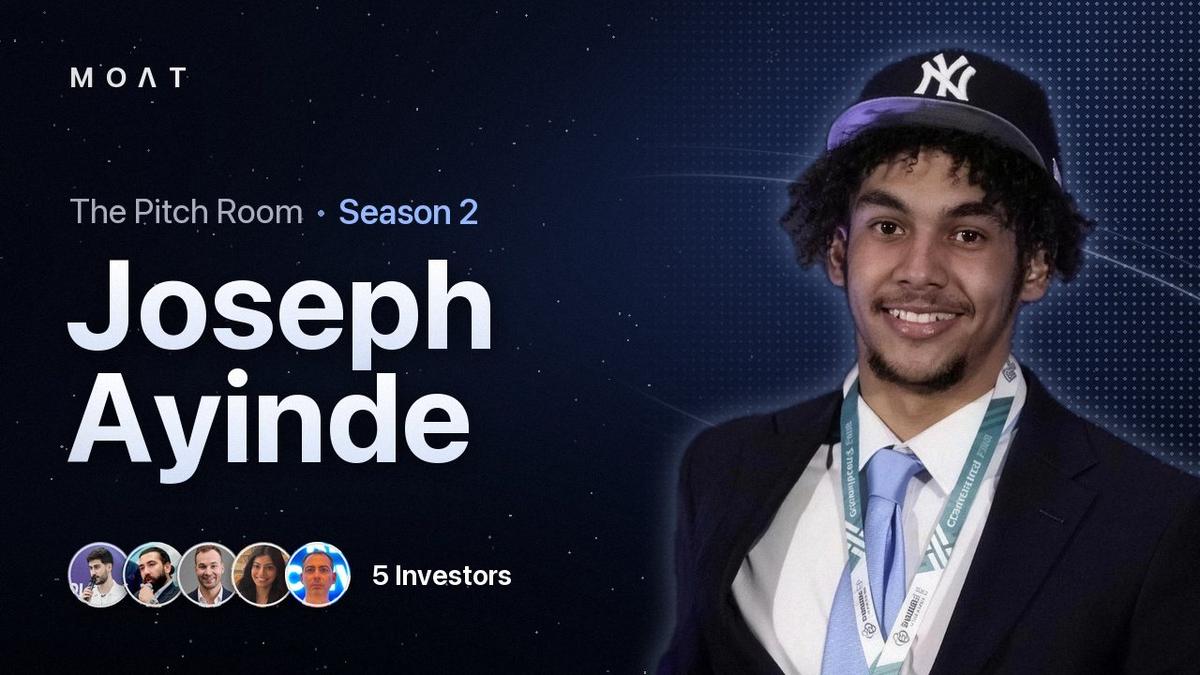
Joseph's company builds a learning layer for clinical AI. When a clinician corrects an AI tool, it captures the correction, turns it into a rule, and checks future outputs against it. Physicians at Mayo Clinic and Roswell Park are using it. At Mayo, it cut unsupported claims in the AI's output from 9.1% to 0.8%. The company is at $40K+ MRR, has just completed SOC 2 and HIPAA, and half of its $5M round is closed.
Then he told the room he'd been accepted to Johns Hopkins and UNC medical schools and turned both down in May to move to San Francisco and build this.
Matthew said medtech normally scares him off because it isn't his area. He said yes anyway, because at angel stage he backs the founder, and Joseph had already done a lot in very little time. All five judges said yes. That's never happened at Moat before.
Traction got Joseph taken seriously. How much he'd done in so little time is what got a yes from a judge outside his usual thesis.
Jordan Feinstein and Kiefer Zang, ReplyCorp: 3 of 5

Brands spend a fortune on organic social and influencer posts, but they can't tell which sales a post drove unless it carries a link or a code. ReplyCorp tracks who engages with a post and matches them to buyers on the brand's side. It's patent-pending, uses the platforms' official APIs, and works on public data only. They have $310K committed on a $500K SAFE.
Aadam asked how it's different from Meta's pixel. Jordan had the answer ready: a pixel can't go inside an organic post. Kiefer added that ReplyCorp works across devices and over time. Matthew, Chris and Aadam said yes. Sareena passed because her fund invests in health. Asjid passed because he expects a lot of competition in the space.
If a giant company could plausibly do what you do, have a one-line answer for why it can't. ReplyCorp did.
Mark Kahanding, Cobalt Academy: 3 of 5
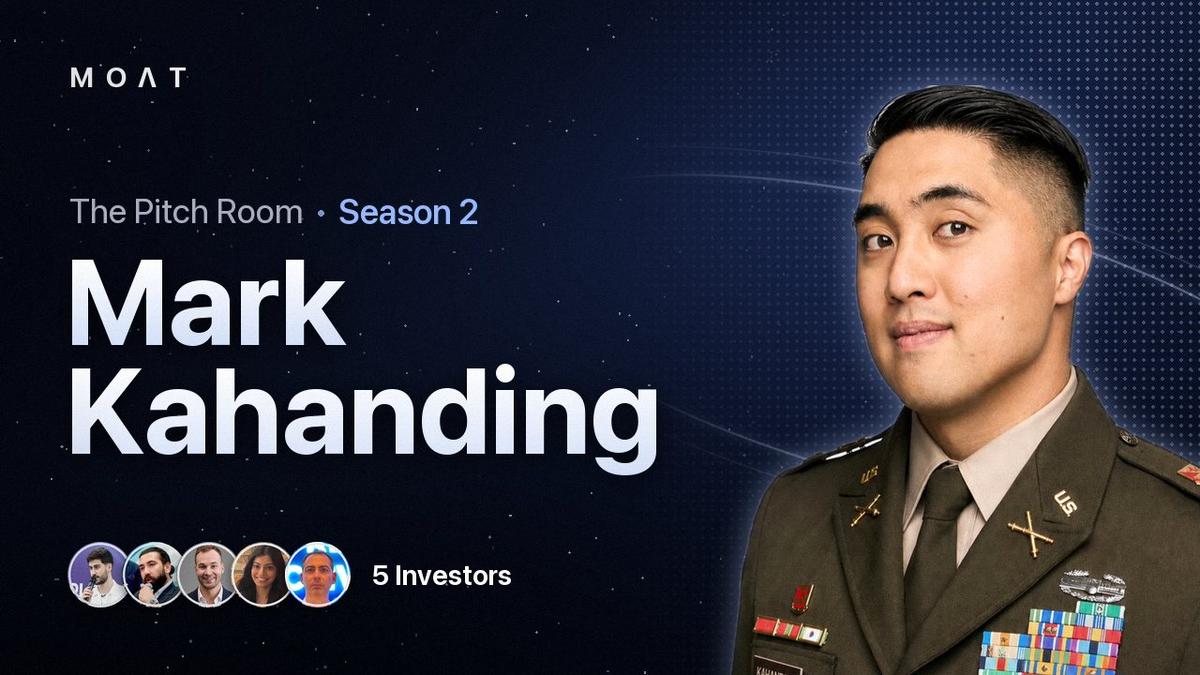
Mark is a former US Army officer who served in Syria. He pitched Ladybug, a cheap anti-drone drone. He has letters of intent from Ukraine and the Netherlands and is raising $1M for mass production, an ITAR licence and battlefield testing.
Matthew guessed the lowest Moat Score of the night for Mark, somewhere around 30 to 40, and still said yes. It's an active space he cares about, and he has his own military history and family connections to Ukraine. Asjid and Aadam said yes too. Chris passed because he doesn't have experience in the industry, and a product that needs reworking every 30 to 60 days worried him without a longer track record behind it.
A high score and a yes are different things. Investors back what they understand and care about, so pitch to the people whose thesis you fit.
Areeb Iqbal, Meducate Robotics: 1 of 5

Meducate builds portable surgical robots. The whole unit fits in a Pelican case, compared with floor-mounted systems that cost £2.4M. The team of 52 includes an ex-F1 CTO and a Harvard Medical School surgeon as CMO. Starting with vets lets them prove the model before they need clinical approval.
Chris called the team strong, but the size of the raise held most of the panel back. Matthew finds medtech regulation and market access too risky. Chris felt a £130M raise at this stage was too big for him, Sareena said the same about stage and round size, and Aadam thought the valuation left too little room for an exit. Asjid said yes, because he sees ways to make the business much more defensible.
A big raise filters your audience. Most angels will pass on a round that size, so Asjid's yes is the one to chase.
Sam Brown, Tiempo: 0 of 5
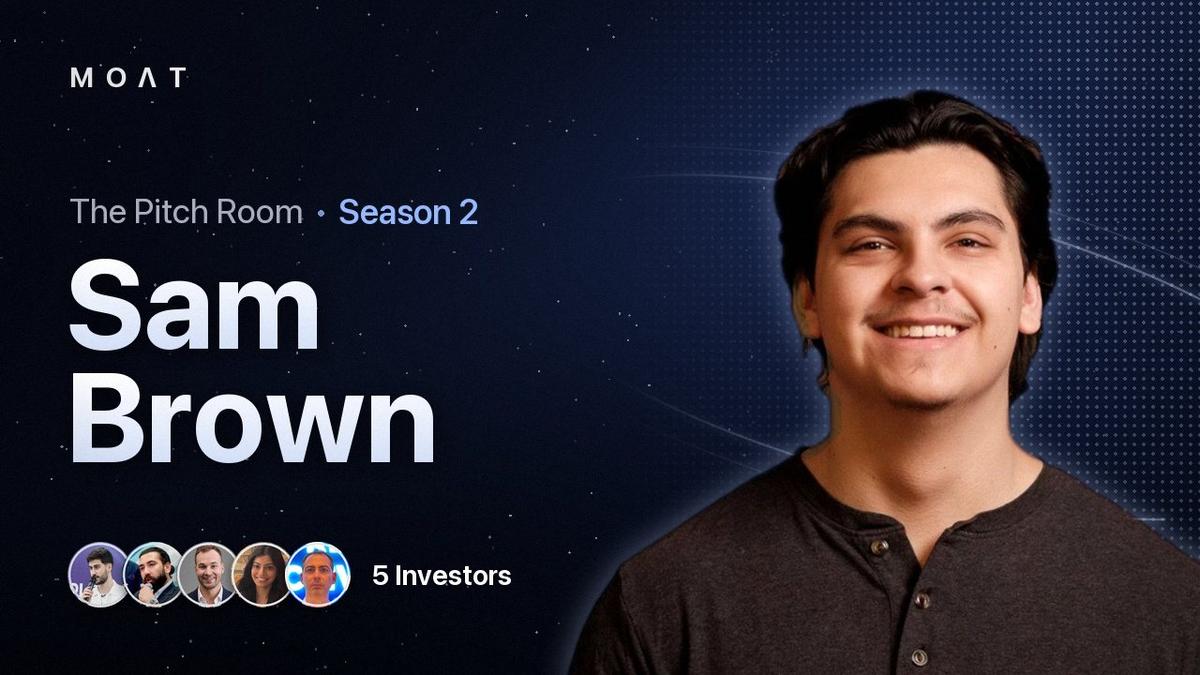
Tiempo matches founders with vetted, local executive assistants within 48 hours. AI tools let one assistant handle up to 10 clients. Sam is at $4.4K MRR with zero ad spend, serving Abu Dhabi and Dubai.
Sam had improved his pitch since Chris last heard it, and he had revenue. It still got five nos. Matthew sees technology replacing the human in this role over the next five to ten years, and Asjid pointed out how fast the technology is improving. Aadam had just been through this himself: he looked for an assistant, ended up using AI, and found it was enough. Asjid added that if he wants a person, he wants one who only works for him. Chris wanted proof of demand and margins, since client matching is still done by hand, and Sareena's fund focuses on health.
Investors look at where a market is going. If a trend like AI looks like a threat to yours, show why you grow as it speeds up.
David Hubbell and Edan Harv, WayWiser: 0 of 5

WayWiser maps how multi-location businesses actually work, then puts AI agents on top. After the first site, every extra location costs almost nothing to map. At one ACE Hardware franchise, scheduling went from 8 hours to 30 minutes and the agents flagged about $2,700 a month in overtime. They've done around $70K in upfront mapping revenue.
Matthew had checked their LinkedIn before the verdict, saw a team of two, and questioned whether they had the experience to scale into enterprise sales. David said they both do: he's run businesses for 25 years and Edan came from Intel. Aadam thinks pricing in this space drifts toward one-off consulting. Chris thinks platforms like Microsoft will end up absorbing this kind of agent layer. Marco's note afterwards: they have strong founder-market fit, and they barely mentioned it.
Your LinkedIn is part of your pitch. If you have relevant experience, put it in the pitch itself, because a judge may have made up their mind before they ask.
Judges' guesses vs real Moat Scores, across two nights
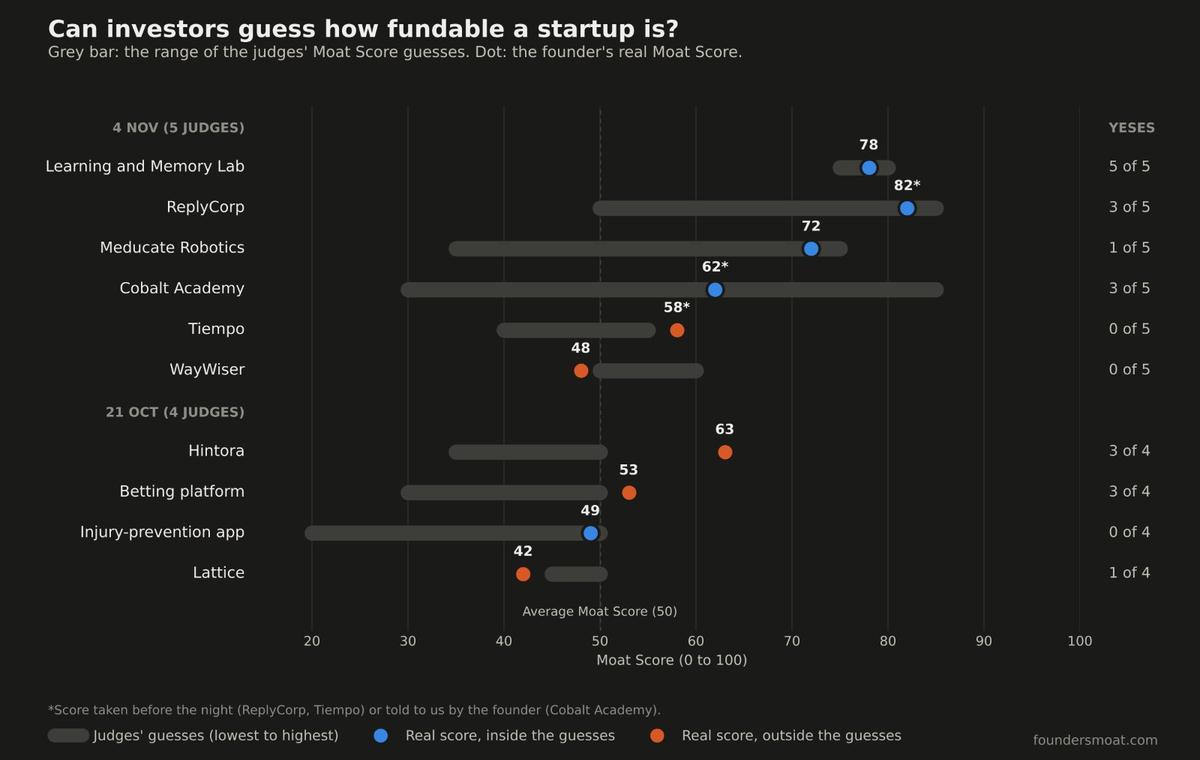
At both sessions, the judges guessed each founder's Moat Score before we revealed the real one. The grey bars show the range of their guesses. The dots show the real score.
| Startup | Night | Judges' guesses | Real Moat Score | Result | Yeses |
|---|---|---|---|---|---|
| Learning and Memory Lab | 4 Nov | 75 to 80 | 78 | Inside the guesses | 5 of 5 |
| ReplyCorp | 4 Nov | 50 to 85 | 82* | Inside | 3 of 5 |
| Meducate Robotics | 4 Nov | 35 to 75 | 72 | Inside | 1 of 5 |
| Cobalt Academy | 4 Nov | 30 to 85 | 62* | Inside | 3 of 5 |
| Tiempo | 4 Nov | 40 to 55 | 58* | 3 above the top guess | 0 of 5 |
| WayWiser | 4 Nov | 50 to 60 | 48 | 2 below the lowest guess | 0 of 5 |
| Hintora | 21 Oct | 35 to 50 | 63 | 13 above the top guess | 3 of 4 |
| Betting platform | 21 Oct | 30 to 50 | 53 | 3 above the top guess | 3 of 4 |
| Injury-prevention app | 21 Oct | 20 to 50 | 49 | Inside | 0 of 4 |
| Lattice | 21 Oct | 45 to 50 | 42 | 3 below the lowest guess | 1 of 4 |
*Scores taken before the night or told to us by the founder (see the results table).
- More real scores fell inside the guesses. On 4 November it was 4 of 6, though this panel had five guessers and much wider ranges. On 21 October it was 1 of 4, and two of the three misses were guesses that came in too low.
- The judges agreed most about the unanimous yes. Joseph's guesses sat between 75 and 80, the tightest range of the night. Mark's ran from 30 to 85.
- The score tracks the yeses, roughly. Across both nights, scored founders who got at least one yes averaged a Moat Score of 65. Those who got none averaged 52. On Wednesday, every founder above 60 got at least one yes. It isn't a perfect predictor, though: Lattice got a yes with a 42.
The two nights side by side
| 21 October | 4 November | |
|---|---|---|
| Founders pitching | 6 | 6 |
| Judges | 4 | 5 |
| Yeses each judge could give | 2 | 3 |
| Yeses given | 7 of 24 verdicts | 12 of 30 verdicts |
| Founders with at least one yes | 3 of 6 | 4 of 6 |
| Average Moat Score (scored founders) | 52 (4 founders) | 67 (6 founders) |
| Highest Moat Score | 63 (Hintora) | 82 (ReplyCorp) |
| Real score inside the judges' guesses | 1 of 4 | 4 of 6 |
| Unanimous yes | No | Yes (Joseph) |
Wednesday's line-up was stronger on paper, with an average score 15 points higher, and the judges were more generous with their yeses. Read more about the 21 October session in why investors pass on startups.
What investors look for: 4 lessons from 30 verdicts
- A market that's heading your way. Tiempo had revenue and got five nos, three of them because judges think AI is squeezing its market. Meducate was pre-revenue and still got a yes, because one judge saw how to make it much more defensible.
- An answer for the giant in the room. ReplyCorp explained why Meta's pixel can't do what it does and got three yeses. With WayWiser, one judge thinks platforms like Microsoft will absorb that layer.
- A team that looks like it can scale. Judges check your LinkedIn. Matthew wasn't convinced a two-person team had the enterprise experience to scale. They say they do, but the pitch didn't show it. Joseph's track record won over a judge who normally avoids medtech.
- A judge whose thesis you fit. Several nos had nothing to do with the startup: one fund focuses on health, and another judge found a big raise too large for his profile. Find out what an investor backs before you pitch them.
Would the panel say yes to you?
The Moat Score is the quickest way to get a rough answer. It's 12 questions, takes about two minutes, and looks at what these judges did: the founder, the market, the product and how hard it is to copy. The average is around 50, so don't panic if that's where you land.
New to the idea of a moat? Start with our startup moat guide.
Thanks to our judges, Matthew Milner, Chris Rohrer, Sareena Bhatia, Aadam Sümer and Asjid Hayat, and to Joseph, Jordan, Kiefer, Mark, Areeb, Sam, David and Edan for pitching. We run The Pitch Room every Wednesday, and you can apply to pitch. See you next Wednesday.
Alex Montoro is the Co-Founder of Moat, a community that helps founders get funded, and co-hosts The Pitch Room, where founders pitch live to angel investors and VCs every week.
FAQ
What do investors look for in a startup?
At pre-seed and seed, most investors look at four things: the founder, the size and direction of the market, early proof that customers want the product, and whether the startup will get harder to copy as it grows. At The Pitch Room on 4 November, the unanimous yes went to Joseph Ayinde, who had traction, a fast-moving market and a founder story that won over a judge outside his usual thesis.
Why would an investor say no to a startup with revenue?
Because they invest in where a market is going. On 4 November, a founder with paying customers and zero ad spend got five nos, and three of the judges said AI was squeezing that market. One expects it to happen over the next five to ten years.
What is a Moat Score?
A score out of 100 for how fundable your startup is, based on 12 quick questions about the founder, market, product and moat. It takes about two minutes, and most founders land around 50.
How do I pitch at The Pitch Room?
Founders are vetted by the Moat team before they pitch. We run The Pitch Room every Wednesday, and anyone can watch for free.
Latest from the blog
-

AI Startup Moats: Easy for You Means Easy for Everyone
Hollywood tech veteran Michael Wise told Moat founders where AI startups can still build a moat, when to pivot, and how to make unpopular calls.
-
LinkedIn Strategy for Founders: 7 Rules From a Ghostwriter
The LinkedIn strategy a 200+ client ghostwriter gave Moat founders: what to post, who to connect with, what to measure, and when to ask for the sale.
-
What is a startup moat? How to measure and build yours
A startup moat is what makes your business hard to copy. Learn the main types, what investors look for, and score your own moat in 3 minutes.